May 8, 2026 • Renata Solís • 9 min reading time • Specs verified June 5, 2026
Neoprene Dumbbell Rack Sets for Instructors: Bulk-Buy Value Breakdown
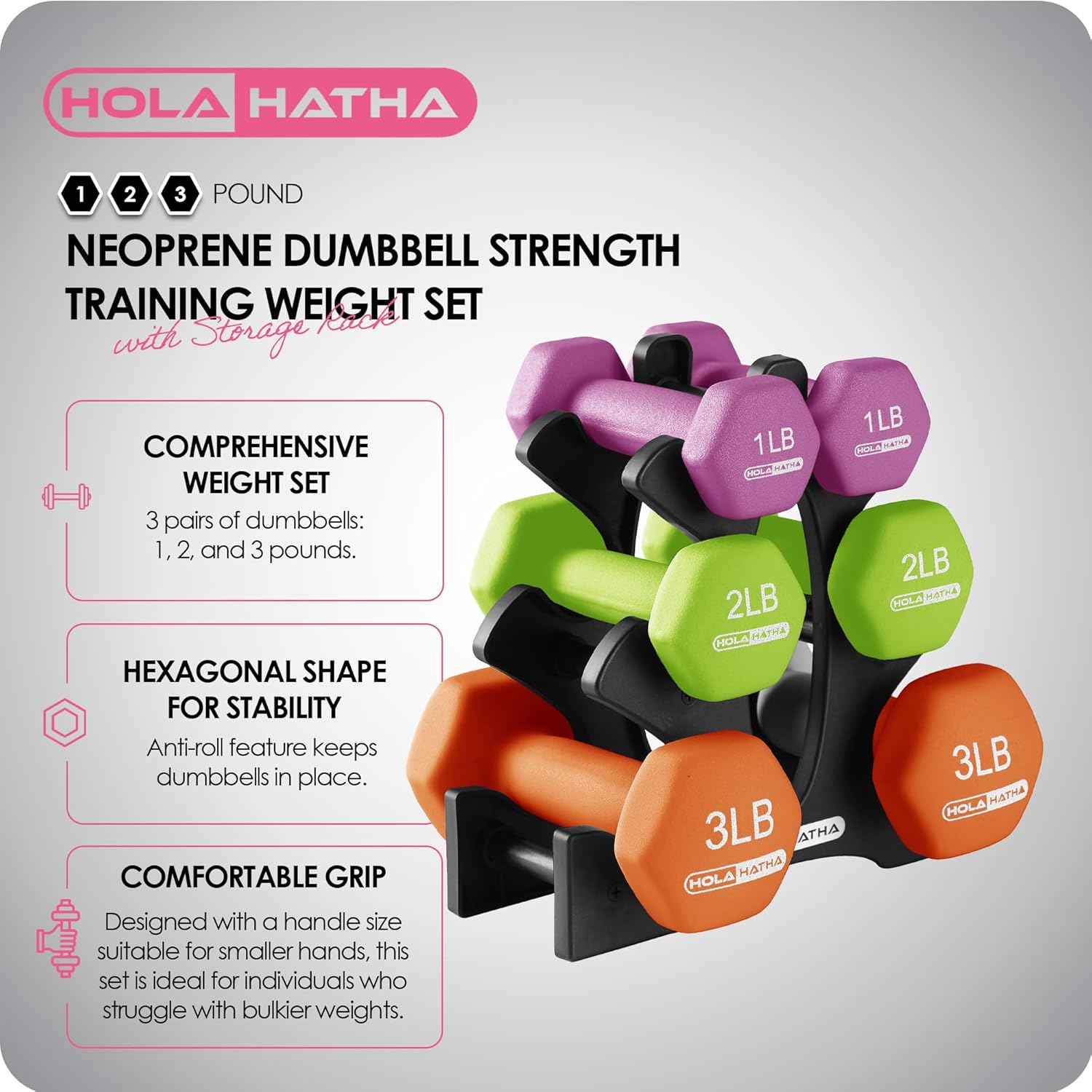
If you’re setting up a group fitness class — think an aerobics room, a Zumba session, or a sculpt-and-tone circuit — one of the first real equipment decisions you’ll face is what dumbbells to put in participants’ hands. Neoprene dumbbells are the rubberized, color-coded hand weights you’ve almost certainly seen in group fitness rooms: they come in fixed weights (usually 1 lb through 20 lb), they’re easy to grip even when hands are sweaty, and they don’t roll, bang, or scratch floors the way bare iron does. A “rack set” just means a matched collection — typically a graduated range of weights on a matching stand — purchased together rather than piecemeal. For instructors and small-studio operators buying for client use, the bulk-buy question isn’t just “which dumbbells?” It’s “which range, how many pairs, at what price point, and from which supplier?” That’s what this breakdown is for.
| EDITOR'S PICK[CAP Barbell 100 LB Set of Neopr…](https://www.amazon.com/dp/B0FL3F6C8T?tag=greenflower20-20) | Mid-tier[HolaHatha Neoprene Dumbbell Wei…](https://www.amazon.com/dp/B095XBG9M4?tag=greenflower20-20) | Budget pick[BalanceFrom Neoprene Coated Iro…](https://www.amazon.com/dp/B0CQKMS2X3?tag=greenflower20-20) | |
|---|---|---|---|
| Weight range | 5–15 LB | 32 LB total | — |
| Pieces | 10 | — | — |
| Material | Neoprene | Neoprene | Neoprene Coated Iron |
| Color options | Color Series | Blue/Red | Color-Coded or Black |
| Grip type | — | — | Non-Slip Grip |
| Price | $139.99 | $62.99 | $33.99 |
| See on Amazon → | See on Amazon → | See on Amazon → |
Why the Buy Decision Is More Complex Than It Looks
On the surface, neoprene dumbbells feel like a commodity. They’re foam-coated or neoprene-dipped hex weights. How different can they really be?
Quite different, it turns out — once you’re running two or three classes a day and the same 8 lb pair is getting grabbed, dropped, and stacked by a different set of hands every 45 minutes. The failure modes that owners and operators consistently report across aggregated reviews aren’t about the neoprene coating cracking on day one. They show up at the six-month and eighteen-month marks: coating separation at the end-cap seams, hex faces that compress under repeated drops until they’re no longer truly hex (and start rolling), and color-coding that fades under UV lighting before the weights themselves wear out. BarBend’s editorial roundup on commercial-grade dumbbells notes that coating thickness and end-cap bonding method are the two specs that most reliably predict long-run durability — and those specs are rarely on the product page for budget sets.
The decision has three real layers:
- Weight range selection — what your programming actually demands
- Build quality vs. per-unit cost math — the tradeoff that separates a one-year buy from a three-year buy
- Supplier and fulfillment logistics — who you’re actually dealing with when something goes wrong at unit 14
Let’s work through each.
Layer 1: Weight Range — Don’t Buy More (or Less) Than Your Programming Needs
The most common bulk-buy mistake instructors make, per the ACE Fitness Group Fitness Instructor Resource Guide, is defaulting to the widest possible range “just in case.” A full rack from 2 lb through 20 lb in 2 lb increments is ten pairs per station. If you’re running a 20-person sculpt class, that’s 200 pairs of dumbbells on your floor — most of which will sit unused in a given session.
A more defensible framework:
For aerobic sculpt, Zumba toning, and barre-adjacent formats: The working range for most participants is 2–10 lb. An instructor-grade recommendation from Verywell Fit’s overview of group fitness equipment is to stock the 3, 5, 8, and 10 lb weights at roughly 1.5x your class capacity (so a 20-person class needs 30 pairs of each weight), and the 2 lb and 12 lb at 0.75x capacity as outliers for beginners and advanced participants respectively.
For circuit training and HIIT formats with a strength component: The range extends upward. The 10–20 lb tier becomes primary, and you’ll want at least 1x class capacity at 12, 15, and 20 lb. The 5 and 8 lb pairs function as the light end for warm-up sets or mobility work.
For dedicated strength-sculpt or muscular endurance formats: Some operators extend to 25 lb neoprene pairs, though above 20 lb the ergonomic case for neoprene starts to weaken — the coating doesn’t add meaningful grip advantage over rubber hex at that load, and per-unit cost climbs sharply.
By the Numbers: Typical Rack Set Configurations
| Format | Core Weight Range | Pairs per 20-Person Class | Estimated Unit Count |
|---|---|---|---|
| Aerobic sculpt / Zumba toning | 3, 5, 8, 10 lb | 30 pairs each weight | 120 pairs |
| Circuit / HIIT | 5, 8, 10, 12, 15, 20 lb | 20 pairs each weight | 120 pairs |
| Full studio (both formats) | 3–20 lb in 2 lb steps | 20+ pairs each | 180–200 pairs |
These are planning figures, not mandates. Your actual class size, format mix, and storage constraints will shift the math.
Layer 2: Build Quality vs. Per-Unit Cost — Running the Real Math
Here’s where intermediate buyers often get tripped up: the per-pair price looks great at the budget tier, but the replacement cycle flips the math.
As of mid-2026, neoprene dumbbells at the consumer-grade tier (think mass-market sporting goods brands) price out at roughly $1.00–$1.50 per pound for individual pairs — so a 10 lb pair runs $10–$15. Rack sets at this tier often include a stand and a range of weights at a discount, landing around $0.80–$1.10 per pound in aggregate when you factor in the bundle pricing.
Instructor-grade and commercial-tier neoprene sets from suppliers like Perform Better (whose commercial equipment catalog documents their bulk pricing for studio operators) run $1.50–$2.20 per pound for individual pairs, with bulk-pricing tiers that begin to close the gap at 50+ pairs of a given weight. The Perform Better catalog structure, as of their 2025–2026 documentation, shows meaningful per-unit price breaks at the 12-pair and 24-pair thresholds for commercial accounts — which is worth a conversation with their sales team if you’re sourcing for a full studio.
The cost-per-use math over a 36-month horizon often favors the commercial tier by a wider margin than the sticker price suggests. Operators in long-run reviews across Garage Gym Reviews’ community aggregations consistently report that consumer-grade neoprene sets in high-rotation studio use need partial replacement at 12–18 months: end caps separate, coatings peel at grip zones, and the hex faces compress under repeated drops on hard floors. If you’re replacing 30% of your pairs annually, the “cheap” set isn’t cheap.
The honest decision rule:
- If your class runs 1–2 sessions per week and you’re in a low-traffic environment: Consumer-grade sets are defensible. The failure timeline doesn’t hurt you.
- If you’re running 3+ sessions per day on a hard floor: The commercial-tier math is almost always better over 24 months. Plan to spend $1.80–$2.20/lb and expect the set to hold without significant replacement.
The Rack Stand Question
Rack stands for neoprene sets are worth a dedicated paragraph because they’re where operators get surprised by hidden costs. Most budget sets include a stand, but owners report that the stands are often the first failure point: the weight-bearing rails bend under full loads, the rubber feet wear down and the stand walks on smooth floors, and the spacing is calibrated for the brand’s specific weights — which means adding pairs from a different source creates awkward gaps or overloading.
Commercial-grade A-frame and horizontal tiered racks from suppliers like Perform Better or direct commercial fitness vendors are sold separately and run $150–$400 depending on capacity. They’re built to OSHA-adjacent loading standards for commercial spaces, which matters both for durability and liability. If you’re in a formal studio environment with liability insurance, the stand quality is worth documenting — some policies have clauses around commercial equipment ratings.
Layer 3: Supplier Logistics — Who You’re Dealing With When It Goes Wrong
Instructors who’ve gone through a bulk purchase once know that the post-purchase relationship is as important as the pre-purchase price. A few things to evaluate before you sign a PO:
Warranty coverage and replacement terms. Consumer brands often offer 30–90 day warranties on neoprene products. Commercial suppliers like Perform Better document longer coverage periods for commercial accounts — this is worth confirming directly, as the terms differ between consumer and commercial-account purchases of what may be the same physical product. Get the warranty in writing, including whether it covers coating separation specifically (a common failure mode that some warranties exclude as “cosmetic”).
Lead time and fulfillment reliability. As of 2026, commercial fitness equipment supply chains have largely stabilized after the disruptions of the early 2020s, but lead times for full rack sets in commercial quantities (24+ pairs of a given weight) still run 2–6 weeks depending on the supplier and season. Pre-semester and pre-January rushes are the highest-risk windows. Build your order timeline accordingly.
Replacement pair availability. A rack set is only as good as your ability to replace individual pairs without buying a whole new set. Confirm with your supplier that the specific weight and color-coding you’re buying will be available as individual pairs in 18 months. This sounds obvious, but SKU discontinuation is a real pattern with budget-tier neoprene lines — operators in long-run reviews frequently note the frustration of a discontinued colorway forcing a full-set replacement to maintain visual consistency.
Per-unit pricing for reorders. If you establish a commercial account, ask about reorder pricing for replacement pairs. Some suppliers lock in per-unit pricing for account holders; others treat every transaction as a new quote. That detail compounds over a multi-year ownership cycle.
The Decision Framework: If X, Then Y
You’ve run the range math, you understand the cost tradeoffs, and you’ve evaluated supplier logistics. Here’s where it resolves:
If you’re running a boutique studio with 3+ daily sessions on hard floors: Invest at the commercial tier. Budget $1.80–$2.20/lb for the weights and a separate commercial-rated rack stand. Source from a supplier with documented warranty terms and confirmed replacement-pair availability. Perform Better’s commercial catalog is the reference point most operators in this segment use, per their documented bulk-pricing structure.
If you’re a certified instructor running 1–3 weekly classes in a shared facility: Consumer-grade sets at $0.80–$1.10/lb in a bundle configuration are defensible, especially if the facility absorbs the replacement cycle. Focus your energy on weight range selection over brand prestige.
If you’re equipping a multi-use training space where neoprene is one format among several: Consider buying the 3–10 lb range in neoprene (where the coating adds real grip value for lighter aerobic work) and moving to rubber hex above 12 lb (where durability per dollar is stronger). This hybrid approach is underused but well-supported by the logic of format-specific wear patterns.
If you’re uncertain about format mix or class volume: Start with a half-capacity order (enough pairs for half your expected max class size), run one full semester, and let your actual usage data drive the second order. The 12-pair commercial pricing tier at Perform Better is low enough to start without full commitment.
The neoprene dumbbell category rewards specificity. The operators who get the best long-run value aren’t the ones who bought the most — they’re the ones who bought the right range, from the right supplier tier, with a replacement plan built in from day one.