May 10, 2026 • Renata Solís • 10 min reading time • Specs verified June 5, 2026
Water Weights and Aquatic Ankle Cuffs for Pool Aerobics: What Holds Up
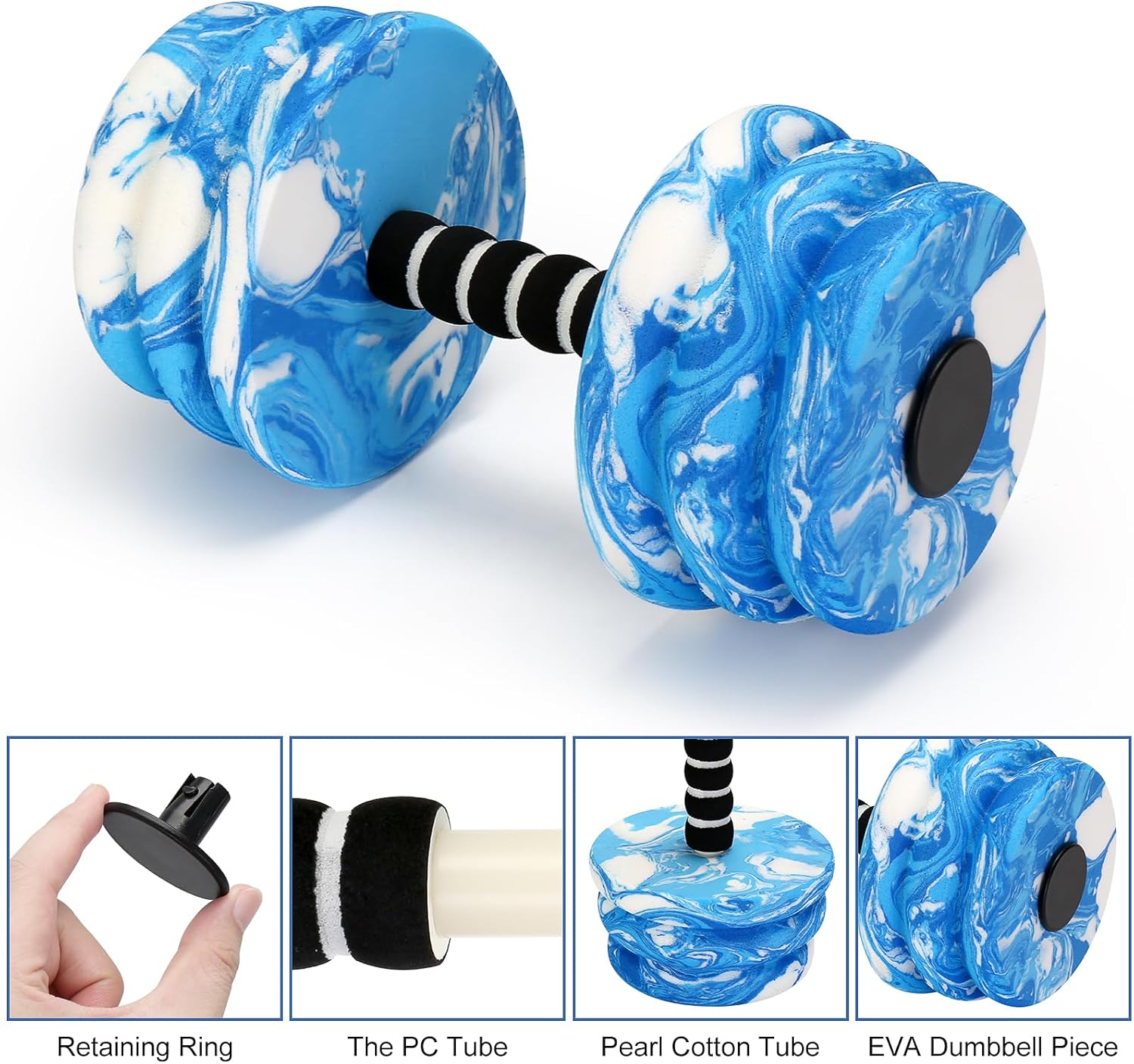
Pool aerobics — structured cardio and resistance exercise done in water — works differently from land-based training in one fundamental way: water itself is already pushing back. Every kick, curl, and lateral raise generates drag that your muscles have to overcome in both directions. Adding purpose-built resistance tools — foam water dumbbells (buoyant, closed-cell foam blocks shaped like barbells) and aquatic ankle cuffs (neoprene or soft-shell cuffs that strap around your ankles and create extra drag as you move your legs) — amplifies that resistance without the joint-compression that comes with free weights on land. The result is a surprisingly challenging workout that’s easy on cartilage and well-suited to a wide range of fitness levels. If you’re shopping for the first time, or outfitting a small studio’s pool program, this guide covers what the published record and the instructor community report about what actually lasts in chlorinated water and daily multi-session use.
Once you’re past the basics, the buying decision gets genuinely complicated. Material degradation in chlorine, buoyancy calibration, strap security at speed, and per-unit cost at bulk quantity all diverge sharply between product tiers. Here’s a full cross-shop.
| EDITOR'S PICK[Hyperwear SandBell PRO Sandbag](https://www.amazon.com/dp/B089DT5Z3K?tag=greenflower20-20)… | Mid-tier[Sporti Fitness Ankle Weights](https://www.amazon.com/dp/B0CSF8G83F?tag=greenflower20-20) -… | Budget pick[THERABAND Ankle Weights](https://www.amazon.com/dp/B00BLGJZ4Y?tag=greenflower20-20) | |
|---|---|---|---|
| Type | Sandbag | Ankle weights | Ankle/cuff weights |
| Weight | — | 5 lb | 1 lb each |
| Material | Neoprene | — | — |
| Water use | — | Yes | — |
| Adjustable | — | — | Yes |
| Price | $52.95 | $29.95 | $18.99 |
| See on Amazon → | See on Amazon → | See on Amazon → |
Why Pool Resistance Gear Fails (and What Good Gear Avoids)
The failure mode for almost every budget aquatic weight is the same: foam delamination or waterlogging. Closed-cell EVA foam — the standard for entry-level water dumbbells — resists absorption when it’s intact. The problem is surface integrity. Cheaper foam coatings develop micro-cracks within three to six months of regular chlorinated pool contact, especially at the handle junction, where stress concentrates during curling movements. Once the surface breaks, the foam begins absorbing pool water, which increases weight unevenly, throws off bilateral balance, and eventually causes the dumbbell to sink rather than float.
ACE Fitness, in their aquatic exercise safety overview, notes that equipment degradation is a genuine participant-safety concern in pool programs — a waterlogged dumbbell that sinks mid-class creates an unexpected load change that can pull an off-balance participant forward. That’s the downstream consequence of buying purely on price.
For ankle cuffs, the failure point shifts to the closure system. Velcro degrades rapidly in chlorinated water — owners across aggregated reviews on retail platforms consistently note that the hook-and-loop strips lose grip strength within three to six months of twice-weekly pool use. A cuff that loosens mid-set becomes a trip hazard and also stops delivering resistance consistently. Quality manufacturers solve this with buckle closures, reinforced double-Velcro with chlorine-resistant coating, or neoprene-and-snap systems that don’t rely on hook-and-loop alone.
By the numbers:
- Budget foam dumbbells (EVA, open-cell or thin-coat): reported usable lifespan of 6–12 months in daily studio use
- Mid-tier closed-cell EVA with sealed coating: 18–30 months in aggregated instructor reports
- Neoprene-wrapped or injection-molded handles: 3–5 years reported in commercial aquatics programs
- Velcro ankle cuff closure: 6-month average before grip failure in chlorinated pools (per Aquatic Exercise Association equipment guidance)
Water Dumbbells: What the Tiers Actually Deliver
Entry tier ($8–$20 per pair): Foam water dumbbells at this price point — the kind sold in pairs at sporting goods chains — are adequate for occasional recreational use. The Aquatic Exercise Association’s facility and equipment standards document distinguishes between “recreational” and “program-grade” equipment; entry-tier dumbbells fall firmly in the former category. Buoyancy is typically 2–4 pounds of resistance equivalent depending on speed of movement (the faster you push through water, the more drag resistance builds). Verywell Fit’s water aerobics equipment guide notes that these are appropriate for beginners learning movement patterns, but warns that surface degradation accelerates dramatically in outdoor pools where UV exposure compounds chlorine damage.
If you’re a first-time buyer doing one or two pool sessions a week in an indoor pool, this tier makes sense. If you’re an instructor buying for studio use, you’ll replace them annually at minimum.
Mid-tier ($20–$45 per pair): This is where you start finding sealed-coat EVA, injection-molded handle cores, and contoured grip shapes that actually reduce hand fatigue during longer class formats. Barbend’s overview of water resistance training principles points out that grip fatigue is underappreciated in aquatic training — because you’re not supporting gravitational load, it’s easy to over-grip, and a poorly shaped handle accelerates this. Brands in this tier typically offer shaped grips and slightly larger surface areas that increase drag without requiring heavier foam.
Owners in multi-year reviews consistently report that the handle-to-foam junction is the durability differentiator in this range — look for specs that describe over-molded or bonded construction rather than press-fit. Press-fit handles work loose.
Instructor/commercial tier ($45–$80+ per pair, often sold in studio sets): At this level, you’re looking at either dense-foam construction with sealed polymer skins, or hybrid designs using internal weighting chambers that add a small amount of fixed resistance on top of buoyancy drag. These are what commercial aquatics programs and certified group-fitness instructors report using across multi-session daily schedules. The per-unit cost math looks steep until you factor lifespan: a $60 pair lasting four years in daily use costs roughly $15/year versus a $15 pair replaced annually.
Shape’s pool workout gear roundup consistently surfaces brands in this tier as the ones worth spending up on for regular practitioners — the recommendation pattern across their editorial coverage over multiple years points to construction quality at the handle and coating durability as the deciding variables, not buoyancy rating, which is relatively consistent across tiers for comparable size.
Aquatic Ankle Cuffs: The Tradeoffs Worth Naming
Ankle cuffs are a different buying problem than dumbbells because the resistance mechanism is entirely drag-based — there’s no buoyancy contribution. The cuff adds surface area around your ankle, which creates more water resistance as you move your legs through kicks, leg presses, and flutter movements. The heavier or more structured the cuff, the more drag. But a cuff that’s too rigid or too heavy creates asymmetric gait that can stress hip flexors over time.
Material tradeoff — neoprene vs. structured foam:
Neoprene cuffs (the soft, wetsuit-like material) are the dominant format. They’re comfortable, conform to the ankle, and — if the neoprene is quality-grade (3–5mm thickness) — hold up well to chlorine. The failure point, as noted earlier, is almost always the closure, not the neoprene itself. When evaluating ankle cuffs, the closure system deserves as much attention as the cuff body.
Structured foam cuffs with a rigid shell exist at the commercial end of the market and are primarily sold through aquatics program distributors. They create more consistent drag because the shape doesn’t compress under water pressure the way neoprene can. The tradeoff is fit variability — they’re less forgiving of ankle circumference differences and generally come in fewer size options.
Fit and sizing — the detail that gets skipped:
ACE Fitness’s aquatic exercise guidance specifically calls out ankle cuff sizing as a safety consideration: a cuff that migrates up the calf during high-speed leg movements changes the resistance profile and can create shear force on the Achilles tendon. Instructors sourcing for studio programs should measure client ankle circumferences and confirm the cuff’s adjustment range covers the full spread before bulk-ordering. Most quality manufacturers publish adjustment ranges in centimeters; treat anything that only says “one size fits most” as a flag.
Resistance gradations:
Unlike land weights where increments are precise, aquatic ankle cuff resistance varies with movement speed — the same cuff delivers more resistance at a fast flutter kick than a slow leg press. This is actually a feature for programming, not a bug, but it means “resistance level” labels on cuffs are marketing approximations, not calibrated figures. Barbend’s water resistance training piece frames this correctly: the relevant variable is surface area and cuff profile, not a stated resistance number. Compare products on published dimensions and profile shape, not the “equivalent to X lb” claims.
Decision Framework: If X, Then Y
Here’s the clean decision tree based on what the published record and the practitioner community consistently support:
If you’re an individual buying for personal pool sessions (1–3x/week, indoor pool): Buy mid-tier foam dumbbells with sealed-coat EVA and an injection-molded or over-molded handle. Expect 18–30 months of reliable use. For ankle cuffs, prioritize a buckle or double-Velcro closure over single hook-and-loop; neoprene thickness of at least 3mm. Budget: $25–$45 per dumbbell pair, $20–$35 per ankle cuff pair.
If you’re a group fitness instructor or Zumba educator running multiple pool sessions per week: Move directly to commercial or instructor-grade dumbbells with polymer-skin or sealed dense-foam construction. The $45–$80 per pair price is justified by the 3–5 year lifespan math and the safety argument — degraded foam creates uneven bilateral resistance that instructors notice and participants feel. For ankle cuffs, source from aquatics program distributors (Perform Better and similar commercial fitness suppliers carry commercial aquatic lines) and confirm adjustment range covers your class demographic’s ankle circumference spread before committing to a bulk order.
If you’re a small studio operator buying 12–20 units for client use: Per-unit cost is secondary to warranty coverage and replacement availability. Prioritize suppliers who offer commercial warranties (12–24 months on construction defects) and carry replacement stock — aquatic equipment in daily multi-session use will need unit replacement on a rolling basis. Buying from a supplier who can fulfill reorders of the exact SKU matters more than saving $5/unit upfront.
If you’re sourcing for an outdoor pool program: UV degradation is an additional failure vector that indoor programs don’t face. Verywell Fit’s equipment guide specifically calls out UV exposure as an accelerant for foam surface breakdown. At outdoor facilities, shorten expected lifespan estimates by 30–40% for any foam-bodied equipment, and factor in storage practices — equipment stored poolside in direct sun degrades faster than equipment stored in shaded, covered bins between sessions.
What to Verify Before You Buy
The aquatic fitness equipment market has a proliferation of unbranded and private-label products at every price tier — the same foam mold appears under dozens of brand names. Before committing, especially at studio quantities, verify three things from the published spec sheet or manufacturer documentation:
- Foam type and coating description — “EVA foam” alone is insufficient; look for “closed-cell,” “sealed-coat,” or “polymer-skin” language that indicates surface integrity.
- Closure system details for ankle cuffs — buckle type, Velcro layer count, and whether the closure hardware is described as chlorine-resistant.
- Warranty terms — specifically whether the warranty covers chlorine exposure damage or excludes it. Many budget warranties void on pool chemical contact; commercial-grade products typically do not.
The Aquatic Exercise Association’s equipment standards documentation is the closest thing to a third-party benchmark for commercial aquatics gear, and it’s worth referencing their published guidance when evaluating vendor claims. ACE Fitness’s facility and equipment standards similarly provide instructor-facing benchmarks for what constitutes program-safe aquatic equipment.
Pool resistance training is one of the more durable investments in group fitness programming — the population who benefits from low-impact resistance work is growing, and aquatic aerobics class enrollment has expanded steadily at community recreation centers and boutique studios through the mid-2020s. The gear that supports it deserves the same rigorous cross-shopping that land-based equipment gets. Buy to the use case, verify the construction specifics, and let the lifespan math make the tier decision for you.